
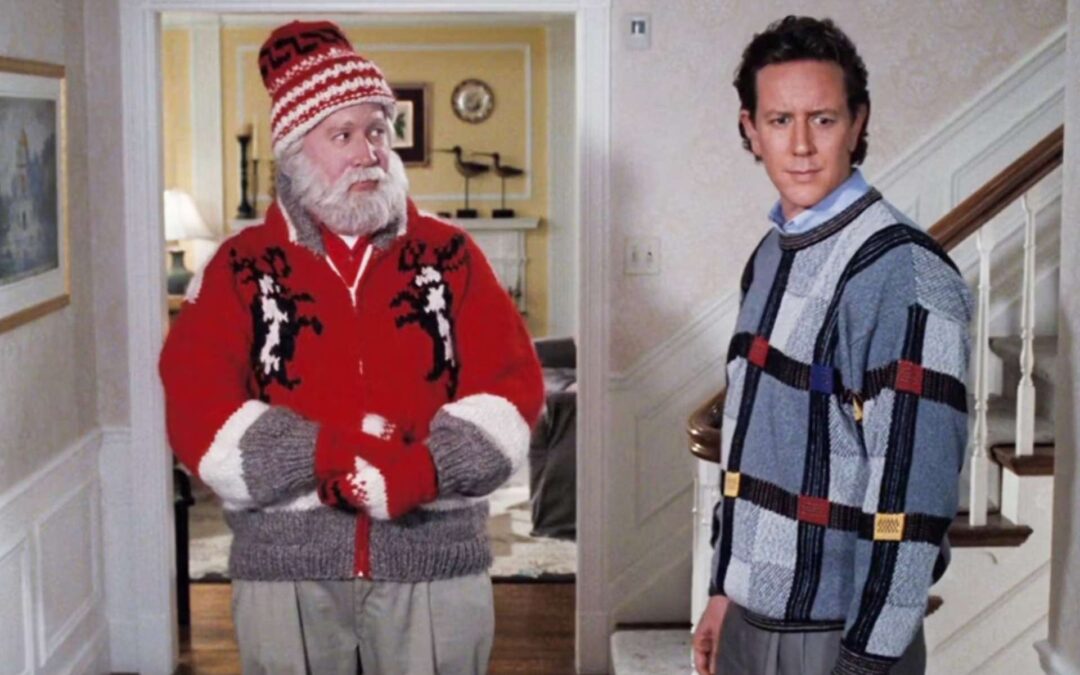
Every year around Christmas, my family and I watch The Santa Clause. It’s funny, nostalgic, and full of magic, but now that I’m both a therapist and a mom, I can’t unsee what’s really going on. My clinical brain ruins a lot of movies, but this one hits different. It’s not just a holiday comedy. It’s a full-on masterclass in emotional attunement, parenting mistakes, and how some people grow up to be therapists without ever actually learning how to connect to another human being.
Let’s start with Neal.
Neal is a therapist who desperately needs a therapist. He’s the cardigan version of control issues. Everything about him screams “I read about feelings once but didn’t like it.” He’s the guy who probably uses “we need to be realistic” as a weapon. Neal’s whole identity is built around being right. He’s not trying to guide Charlie. He’s trying to win.
When Neal tells Charlie that Santa isn’t real, it isn’t about truth. It’s about control. He can’t stand not being the authority in the room. In therapy terms, he’s completely misattuned. He doesn’t meet Charlie in his world. He drags Charlie into his. Instead of curiosity, there’s correction. Instead of wonder, there’s a lecture. And you can tell this is learned behavior. People like Neal often come from homes where emotions were unsafe or ignored. Somewhere in his childhood, Neal learned that feelings meant weakness and uncertainty meant danger. So he built his armor out of logic.
Now as an adult, he’s all intellect and zero awareness. He’s the kind of therapist who can quote Carl Rogers but has never actually practiced unconditional positive regard. He has the language but not the heart. He’s so busy diagnosing the world that he forgets to feel it.
Then we have Laura, Charlie’s mom. She’s kind, she’s warm, and she’s completely absent when it matters. While Neal chips away at Charlie’s belief, Laura sits quietly by. I get it. Co-parenting is hard. Divorce makes people pick their battles. But this is one she should have picked.
Laura represents the parent who doesn’t want to make waves. The one who wants peace at all costs, even when that peace comes at her child’s expense. When she lets Neal take over, she teaches Charlie that adults who love you might still let someone else hurt you emotionally. Her silence is not neutral. It tells him, “Your feelings aren’t worth protecting if it makes someone else uncomfortable.”
In therapy, we call that a boundary collapse. And it doesn’t just happen in movies. It happens every day when parents avoid conflict instead of showing up for their kid.
Now let’s talk about Scott Calvin. He starts out like the classic emotionally unavailable dad. He’s there, but he’s not there. He’s distracted, defensive, and disconnected. He shows love through gifts, not presence. He thinks being a parent means showing up physically, not emotionally.
But something shifts. When Scott literally becomes Santa, he learns what real attunement looks like. He slows down. He listens. He sees Charlie. For the first time, he’s curious instead of critical. He moves from performing love to actually giving it.
That’s what attunement is. It’s emotional rhythm. It’s matching the other person’s energy and staying in sync with their internal experience. It’s noticing when they pull back and adjusting your approach instead of pushing harder. It’s the difference between “I hear you” and “I see you.”
Scott learns it by accident. Neal never does. That’s the real arc of the movie. One father learns to connect. The other keeps hiding behind logic and calling it love.
There’s this moment in the movie when Charlie realizes the adults don’t believe him. You can see his face change. That’s the look of a kid who just learned his truth isn’t safe. Neal and Laura think they’re helping him by grounding him in reality, but what they’re actually doing is teaching him to doubt himself.
In therapy, we call that a rupture in emotional safety. When adults invalidate a child’s experience, even if their intention is good, the message lands as “you can’t trust what you feel.” It’s unintentional gaslighting, but it still hurts.
Kids need fantasy. They need play and imagination. Those things build empathy, creativity, and resilience. Believing in Santa is not about the man in red. It’s about learning to hold hope and joy at the same time. When you shut that down too early, you don’t raise a realist. You raise an anxious adult who can’t tolerate uncertainty.
Letting kids believe doesn’t make you a liar. It makes you emotionally intelligent. It means you value their inner world enough to let it exist before reality starts taking pieces of it away.
Now I watch The Santa Clause with my daughter. She’s four and full of questions. “How did Santa die?” “Why doesn’t Neal believe in Santa?” “Can reindeer really fly?”
It’s hilarious and sweet and also a little profound. I find myself explaining things I never thought I’d have to. I tell her, “Some grown-ups forget how to believe. They stop seeing magic because they think being smart means being serious.” She nods like this makes perfect sense and goes back to giggling about reindeer farts.
Watching it with her is like therapy for me too. I get to see the story through her eyes, full of curiosity and wonder. I get to remember what it feels like to believe in something just because it feels good. I get to choose attunement in real time.
When she asks questions, I don’t rush to give her the “truth.” I meet her where she is. I let her imagine. I let her believe. Because that’s what emotionally safe parenting actually is. It’s not about protecting kids from disappointment. It’s about walking beside them through it.
The moral of The Santa Clause isn’t about Santa at all. It’s about belief. It’s about attunement. It’s about how adults either nurture or destroy magic based on how comfortable they are with their own inner child.
Scott learned to connect. Laura avoided conflict. Neal wanted control. Three different coping styles, one little boy caught in the middle.
As a therapist, I see it clearly. As a mom, I feel it even more. And as someone who gets to watch it all over again with a child who still believes in the impossible, I’m reminded that attunement isn’t just clinical. It’s love in motion. It’s presence. It’s listening when the world tells you to correct.
And maybe that’s the real magic of Christmas. Not Santa, not gifts, not the sleigh. Just the simple, radical act of being there.