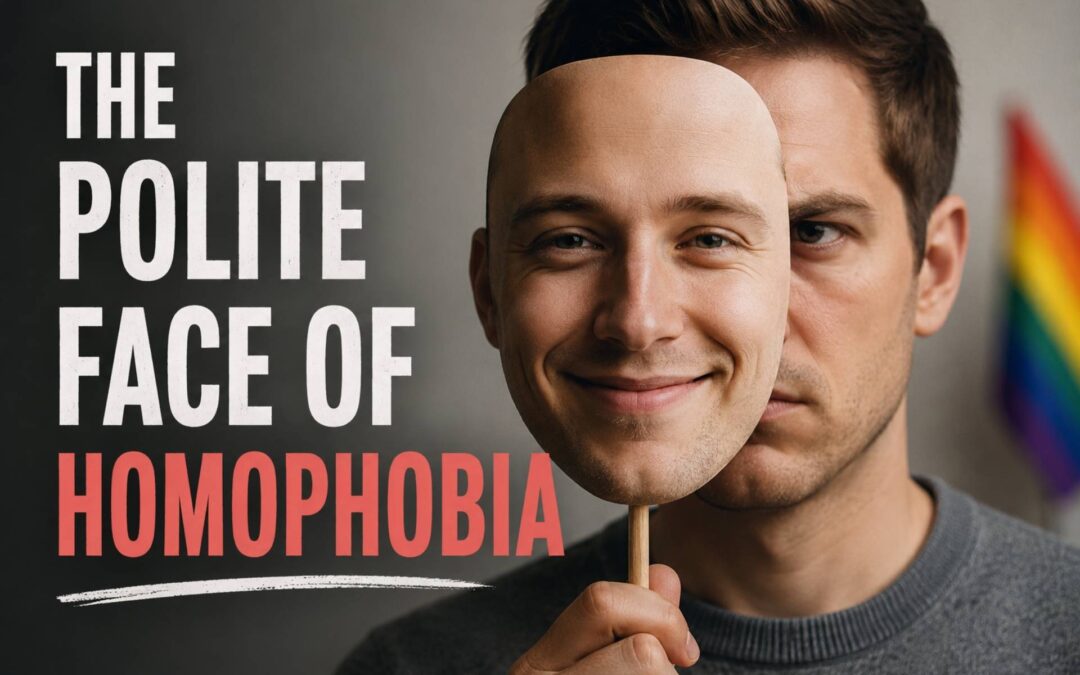
The older I get, the more I realize that many people carrying homophobia do not even recognize it in themselves anymore. They think homophobia has to look loud to count. They think it has to look violent, aggressive, obvious. So they never examine the discomfort they feel around queer visibility, queer relationships, queer joy, queer marriage, queer families, or queer identity because they convinced themselves their intentions matter more than their impact.
Especially in the South, prejudice learned how to clean itself up. It learned how to sound polite, thoughtful, religious, and “loving.” It hides inside phrases people repeat so casually they no longer even hear the harm in them anymore. “I love everybody, but…” “I support them, I just don’t agree with it.” “I’m Christian.” “I don’t hate gay people.” Somewhere along the way, people convinced themselves that if they softened the language enough, the cruelty somehow disappeared too.
But queer people notice the difference between being fully accepted and being quietly tolerated. We always notice.
People convince themselves their discomfort stays hidden because it lives internally. They think if they never say the harsh thing out loud then nobody can feel it. But queer people spend their entire lives learning how to read safety. They notice the hesitation when they mention their partner. They notice when someone suddenly becomes tense discussing gender identity. They notice when support disappears the moment queerness stops being abstract and becomes visible.
People convince themselves their discomfort stays hidden because it lives internally. They think if they never say the harsh thing out loud then nobody can feel it. But queer people spend their entire lives learning how to read safety. They notice the hesitation when they mention their partner. They notice when someone suddenly becomes tense discussing gender identity. They notice when support disappears the moment queerness stops being abstract and becomes visible.
That quiet disgust people think they are hiding so well is often INCREDIBLY loud.
And nowhere does this feel more dangerous to me than inside mental health spaces.
Therapists love to believe they are naturally safe because they entered a helping profession. But being a therapist does not automatically make someone affirming, self-aware, or free from prejudice. Some of the most painful stories queer clients carry happened inside therapy offices. Not always through blatant cruelty either. Sometimes through silence. Through subtle avoidance. Through feeling like their therapist tolerated them rather than fully saw them.
I think some clinicians truly underestimate how deeply clients feel what is unspoken in a room.
A therapist does not have to openly condemn a queer client for harm to occur. Harm can happen in the pause after a teenager mentions their girlfriend. It can happen when a therapist suddenly becomes overly clinical discussing gender identity. It can happen when a therapist cannot even comfortably say the words “gay” or “queer” out loud without awkwardness creeping into the room. When they avoid the language completely, lower their voice when saying it, dance around identity labels, or act visibly embarrassed by queer terminology itself. It happens when couples therapists claim they are unable to work with queer couples at all, as if queer relationships are somehow too controversial, too uncomfortable, or too morally complicated to deserve competent care like everyone else receives. It can happen when someone claims to be “neutral” but only becomes cautious, distant, or morally conflicted when queer topics enter the conversation.
Queer clients know when they are being carefully managed instead of genuinely embraced.
And honestly, I think too many therapists want credit simply for not being openly hateful.
Tolerance is not the same thing as safety.
A queer person should not have to enter a therapy office wondering whether their therapist secretly believes their identity is sinful, morally wrong, inappropriate, or unfortunate. That is not radical acceptance. That is conditional tolerance disguised as professionalism.
Real radical acceptance means fully recognizing queer people as whole human beings deserving of dignity, joy, safety, relationships, celebration, complexity, and love without secretly framing their existence as something tragic or morally questionable.
It means queer relationships are not treated differently from straight ones. It means a trans client does not have to spend half the session assessing whether their therapist secretly disagrees with their identity. It means queer joy gets celebrated instead of analyzed, and clients leave therapy feeling more human instead of carrying even more shame home with them.
And frankly, I think some therapists need to ask themselves harder questions.
If your first emotional reaction to queer identity is discomfort, fear, anxiety, moral conflict, or disgust, have you actually done enough personal work to ethically serve queer populations?
Because ethical care requires more than good intentions.
It requires self-awareness.
It requires humility.
And sometimes it requires admitting that what you once labeled “beliefs” may actually be prejudice you never fully unpacked.
I know religion becomes part of this conversation quickly, especially in the South, and I want to be clear that this is not an attack on Christianity itself. There are deeply affirming Christians doing beautiful work every single day. There are churches creating life-saving spaces for queer people. But faith does not exempt someone from accountability.
I am deeply tired of watching religion used as a shield for prejudice while everyone pretends the harm somehow disappears because the belief feels spiritually justified.
And honestly, I think there are many Christians who have never fully stopped to examine how deeply normalized anti-queer messaging became inside church culture.
Not because they are all intentionally cruel.
But because many were raised inside environments where discomfort around queerness was treated as righteousness.
Where silence was treated as morality.
Where exclusion was framed as “love.”
Where queer people were welcomed right up until they wanted visibility, marriage, leadership, celebration, honesty, or full belonging.
I think there are Christians reading this right now who genuinely believe they are loving people while still feeling uncomfortable hearing the word queer. Christians who believe they are accepting because they would never scream at a gay person, while still quietly believing queer relationships are less holy, less moral, less worthy, or less deserving of celebration than straight ones.
And that is exactly the kind of internalized bigotry people refuse to confront because it feels normal to them.
It looks like saying, “I don’t judge anyone,” while refusing to attend a queer wedding.
It looks like saying, “I love everybody,” while voting against queer protections.
It looks like saying queer people are welcome in your church while also believing their relationships should remain hidden, quiet, celibate, or apologetic.
It looks like feeling uncomfortable seeing two men hold hands in public while still insisting you are not homophobic because you would never say something hateful out loud.
It looks like therapists claiming they are affirming while refusing to post about Pride because they are worried what other Christians might think.
And I think many people truly do not realize how harmful this becomes because they were taught to see queer discomfort as spiritually acceptable.
But if your version of love consistently requires queer people to shrink themselves, censor themselves, hide themselves, or soften themselves to make others comfortable, then that is not radical love.
That is conditional acceptance.
And queer people feel the difference every single time.
When people say things like, “I can love the sinner and hate the sin,” they often fail to understand how dehumanizing that feels to hear about something as intrinsic as identity and love. Imagine constantly hearing that the deepest experience of your relationships, intimacy, family, and connection is something others find morally disturbing while still insisting they “love” you.
That is not neutral.
And the impact of those beliefs reaches far beyond hurt feelings.
Queer children hear it.
Teenagers absorb it.
Adults spend years untangling it.
People grow up learning to monitor their voices, their clothing, their mannerisms, their friendships, and their safety because they understand very early that acceptance is conditional.
I think what frustrates me most is how often people confuse politeness with kindness. The South especially has mastered this. People will smile warmly while excluding you. They will preach love while quietly supporting systems that create shame, rejection, homelessness, trauma, and fear for queer communities.
And then they become defensive when someone calls that harm exactly what it is.
Bigotry does not become morally acceptable simply because it sounds softer than it used to.
You do not become safe because your prejudice is wrapped in politeness.
And you do not become ethical because your discrimination is religiously motivated.
I think part of why these conversations create such intense defensiveness is because many people are deeply attached to seeing themselves as compassionate. They want to maintain discriminatory beliefs while still being viewed as loving and accepting.
But those things do not always coexist.
Sometimes growth requires people to sit in the discomfort of realizing they may have caused harm despite believing they were kind.
And honestly, I am less interested in protecting fragile feelings than I am in protecting vulnerable people.
There are too many queer individuals carrying religious trauma, too many people estranged from their families, too many clients sitting in therapy rooms terrified to fully tell the truth, and too many teenagers questioning whether they deserve love, safety, or belonging.
And still there are professionals more focused on defending their intentions than examining their impact.
I want queer people reading this to know something very clearly: you are not asking too much by wanting genuinely affirming care.
You are not dramatic for wanting safety.
You are not difficult for wanting a therapist who fully sees you instead of merely tolerating you.
And if you have ever left a therapy session feeling smaller, more hidden, more ashamed, or emotionally unsafe because of a therapist’s beliefs or discomfort, I am deeply sorry.
That should never happen.
At Works Counseling Center, we believe queer people deserve radically affirming care. Not performative acceptance. Not quiet judgment hidden behind professionalism. Real safety. Real humanity. Real belonging.
Our clinicians include queer therapists and deeply queer-allied therapists who believe people deserve spaces where they can exist fully without shrinking themselves to make others comfortable.
We know many clients are carrying years of shame, fear, rejection, identity trauma, and religious trauma. We know how exhausting it is to constantly assess whether a space is truly safe before you can even begin healing.
If you are queer and looking for a therapist where you can breathe fully, speak openly, and exist authentically, there is space for you here.
And honestly, I also want to speak to the people reading this who feel uncomfortable because somewhere deep down they recognize themselves in parts of it.
If you are beginning to realize you may carry internalized homophobia, that does not mean you are beyond growth. But it does mean there is work to do.
Real work that requires honesty instead of defensiveness, curiosity instead of denial, and accountability instead of constantly hiding prejudice behind prettier language.
At Works Counseling Center, we are willing to help people sit with that discomfort too. We are willing to help unpack where those beliefs came from, how they formed, and what it looks like to move toward something healthier, safer, and more humane.
Because growth is possible.
But growth only happens when people stop pretending quiet prejudice is harmless.
Queer people deserve more than survival. They deserve safety, joy, belonging, and communities where they are not constantly asked to justify their humanity in order to receive love or respect.
And they deserve mental health spaces where their humanity is never treated like a debate.